Size & Capacity
Designer Small Bag Capacity Checklist
A useful small-bag comparison starts with your required items, then checks the opening, internal arrangement and ability to close the bag comfortably. External dimensions and size names help narrow a shortlist, but they do not prove what fits. This checklist is a method you can use, not a record of hands-on testing.
Draft editorial check:
On this page
- Use a three-gate fit record
- Start with the items you cannot leave behind
- Compare the opening before the outside measurements
- Usable space is different from geometric volume
- Use official fit examples carefully
- Try a repeatable packing sequence
- Keep a simple decision record
- Continue your research
- Use a three-gate fit record
- Sources and calculation method
- Questions before purchase
Use a three-gate fit record
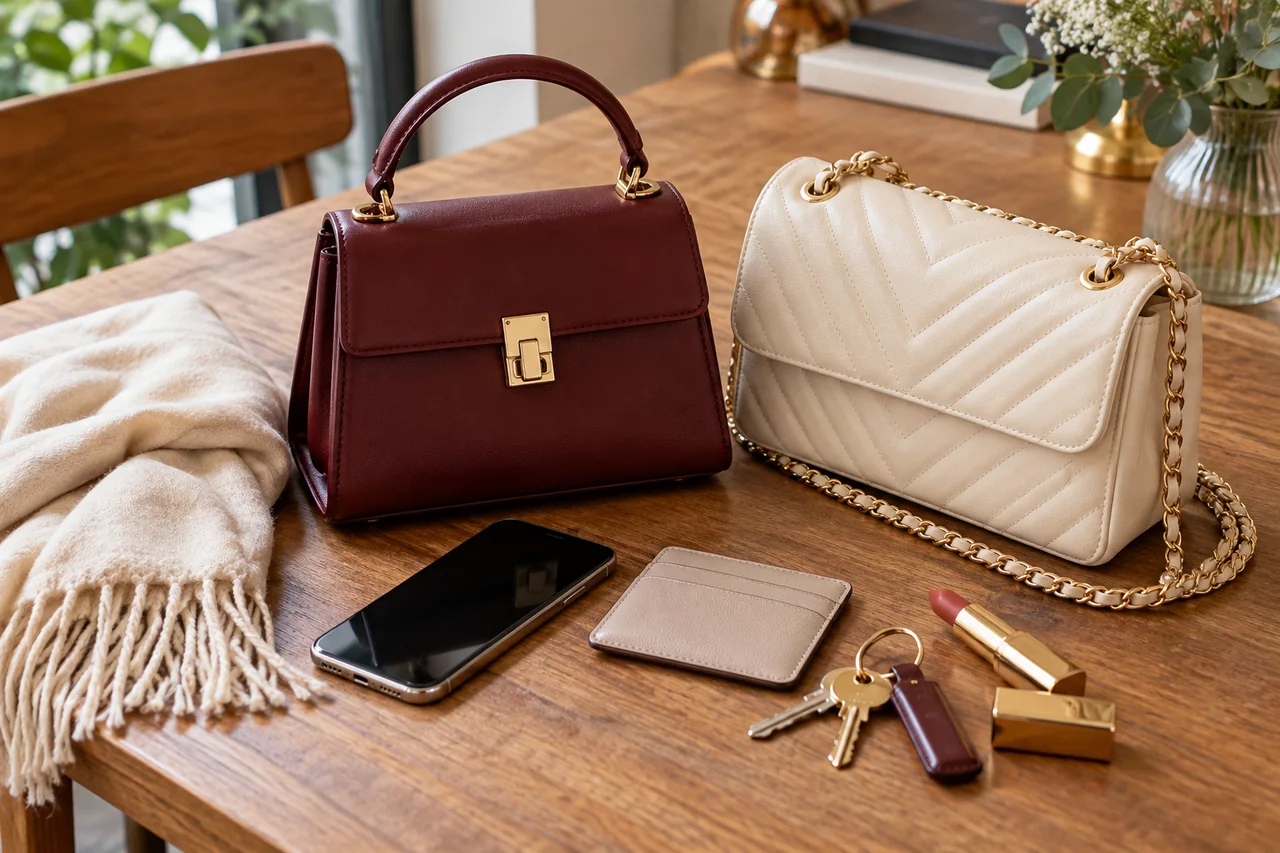
A17×8×2 cm phone-and-case example is excluded by a rigid internal opening of 16 cm if it cannot be rotated through; a larger exterior width would not reverse that result. Gate 1 is entry, gate 2 is coexistence with the wallet and keys, gate 3 is closure without force. Record each gate as pass, fail or unverified. The dimensions are a geometry example, not a tested phone or bag combination.
Start with the items you cannot leave behind
Empty your current bag onto a clear surface and separate necessities from optional extras. Keep protective cases, key rings and normal containers attached. Removing them can make a demonstration look successful while creating a packing arrangement you would never use.
Write a short must-carry list. Include your phone, payment essentials, keys and any personal necessities. Add glasses if you rely on them. Then identify the largest rigid object. That object often sets the first practical constraint because it cannot adapt its shape to an available corner.
Do not buy around an imagined future routine unless you are willing to change what you carry. A bag that only works after leaving essential items behind has failed your checklist, even if the empty silhouette is appealing.
Compare the opening before the outside measurements
A large-looking body can still have an opening that is awkward for your particular items. Ask for the usable opening measurement if it is not published, and distinguish that measurement from the overall width of the bag.
Swipe the table horizontally to see all columns.
| Check | What to observe | What it does not prove |
|---|---|---|
| Opening | Can the largest item enter without force? | That the whole load fits |
| Interior | Can essentials sit together naturally? | That access will be convenient |
| Closure | Does it fasten without pressure? | That the packed bag is comfortable |
| Retrieval | Can frequently used items be removed easily? | That another person's packing will work |
| Carry | Does the realistic load suit your preferred position? | Long-term comfort or durability |
These criteria apply to the item you are considering. They should not be converted into unsupported rankings across entire brands.
Usable space is different from geometric volume
Multiplying exterior length, height and depth gives the volume of an imagined box. A handbag has seams, lining, closures and shapes that do not necessarily follow that box. Compartments can help separate belongings while also restricting where a large object can sit.
Soft sides do not justify a promise of extra capacity. Expanding a bag with pressure may change its intended shape or make the closure difficult to use. Similarly, a structured interior should not automatically be called less practical: the arrangement may suit someone whose objects match its compartments.
Choose the layout that accommodates your actual contents. Avoid a universal score based only on the largest external measurement.
Use official fit examples carefully
For the selected Balenciaga Le City Small reference, the brand mentions a smartphone and a tablet without naming either device. That wording is a starting point for questions, not proof that your tablet and keyboard case fit together. Official Balenciaga example, checked 16 October 2026.
A different example is the selected Fendi Baguette Soft Medium reference, whose official description includes an internal drawstring compartment. That is a construction detail to consider during an access check, not a quantified packing result. Official Fendi example, checked 16 October 2026.
This independent comparison uses Fendi and Balenciaga as examples of product-level research. It does not rank either brand, claim equivalent capacity or imply that all bags within either collection share these features.
Try a repeatable packing sequence
Use the same essentials for each candidate. Otherwise, the comparison becomes a test of different packing lists rather than different bags.
- Begin with the largest rigid item in its regular case.
- Add the remaining necessities without stacking heavy objects on fragile ones.
- Fasten the closure fully without pressing the contents down.
- Retrieve your phone, keys and payment item in the order you normally use them.
- Replace each item while standing.
- Try the bag in your usual carry position with suitable clothing.
If a store or seller does not permit a physical test, request the missing measurements and clear interior photographs. Record the result as unverified until you have adequate evidence. A paper outline can help you visualize scale, but it cannot reproduce the opening, lining or behaviour of a real bag.
Keep a simple decision record
For each candidate, note the exact reference, source date, required items, known dimensions and unresolved questions. Use outcomes such as “confirmed by my permitted check,” “manufacturer example only” and “not yet verified.” This makes the evidence clearer than a vague capacity rating.
Also record what you would need to change. Switching from a long wallet to a cardholder is a choice; it should not disappear from the comparison. A bag that fits your current routine may be preferable to one that requires several compromises.
Continue your research
Use the 1688bags model guides to identify exact references, then apply this checklist to the particular item you are considering. Editorial specifications do not verify a seller's stock, authorization or authenticity claims.
Use a three-gate fit record
Edit this local table, then copy it into your sourcing request. Entries are not saved or sent automatically.
Example / reference — edit the fields below
Complete with your own requirements; unknowns stay pending.
Related reading
Sources and calculation method
Research reference date: . This is a source-reference date, not a publication date or a hands-on test.
Method: the editorial comparisons use the cited specifications; worked calculations state their assumed inputs. Product-page descriptions do not establish physical fit, material performance or stock.
Questions before purchase
Can I trust a phone-fit claim without a phone model?
Treat it as general guidance. Phone size, protective cases and the other packed items still need checking.
Does a wider bag always hold more?
No. Opening size, shape, internal divisions and object arrangement can matter more than a single exterior dimension.
Is this checklist based on physical tests?
No. It provides a repeatable evaluation method and clearly attributed official examples. It does not report measured capacity or tested packing combinations.