Packing & Shipping
Multi-Seller Bag Orders: Consolidate or Ship Separately?
Consolidation can simplify a multi-seller shipment, but it is not automatically cheaper or faster. Compare the packed dimensions, weight, handling charges and waiting time for both options, and decide what to do if one seller is late.
Draft editorial check:
On this page

Calculation and purchase decision
Compare identical contents, destination and service. Suppose two cartons are 40 × 30 × 30 cm and 5 kg each; at an assumed 5,000 cm³/kg divisor each has 7.2 kg dimensional weight, totaling 14.4 kg before billing rounding. A combined 60 × 40 × 35 cm carton at 10 kg has 16.8 kg dimensional weight. Consolidation increases the weight basis by 2.4 kg in this example. It may still reduce other fees, but those need a quote.
DHL’s volumetric-weight guide supports the cm-based method and a typical Express divisor of 5000, while requiring confirmation of the actual service divisor. The carton sizes above are editorial assumptions. The calculation does not establish a CBAG rate, a promised route or a freight saving.
Compare the same destination and contents
Ask for two options using the same SKU quantities, delivery address and packing protection: one consolidated shipment and separate releases. Keep China domestic freight, receipt handling, storage if applicable, QC, repacking and international charges visible. Unknown charges stay pending, not zero.
A rate based on one carton cannot be compared with another option based on unmeasured seller parcels. Ask which figures are estimates and which have been measured, how chargeable weight is calculated for each route, and when the quote expires.
Swipe the table horizontally to see all columns.
| Consolidate when | Consider separate release when | Confirm before deciding |
|---|---|---|
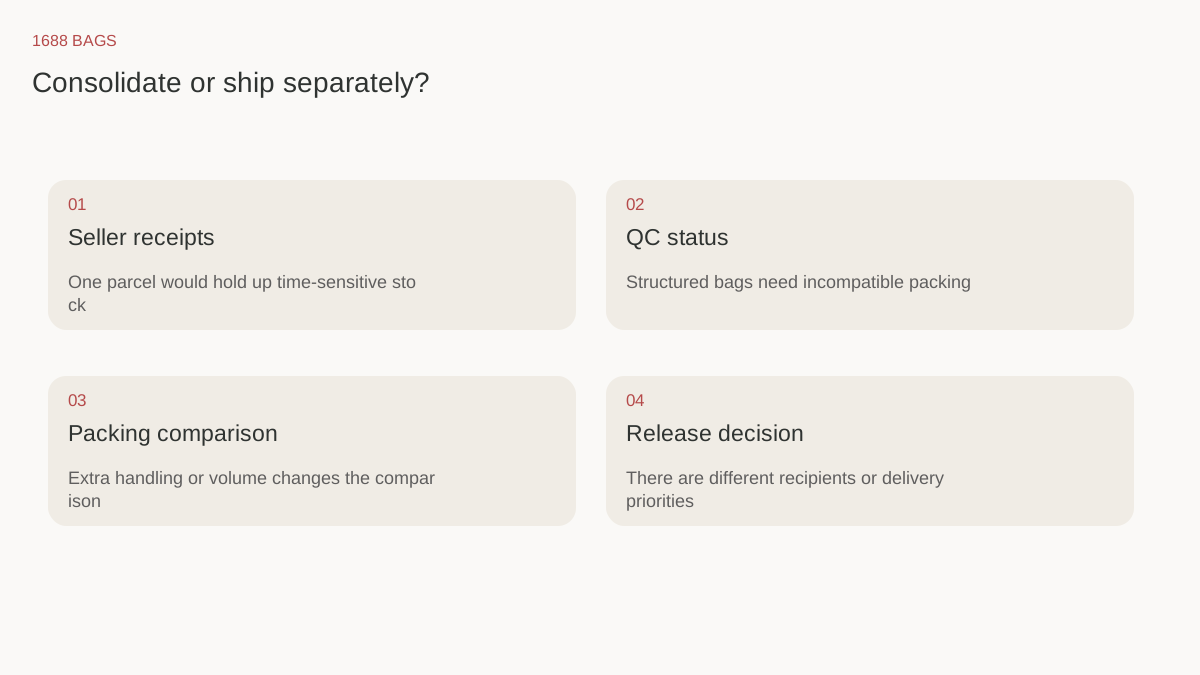
| All sellers can meet the agreed warehouse cutoff | One parcel would hold up time-sensitive stock | Arrival status and latest release date |
| Products can share protection without crushing | Structured bags need incompatible packing | Packing layout and approval photos |
| The complete quote is acceptable | Extra handling or volume changes the comparison | Included, excluded and pending fees |
| One recipient and destination suit the shipment | There are different recipients or delivery priorities | Address and route eligibility |
Set an exception rule for the late parcel
Record whether the desk should wait, quote a split shipment, or ask you before the release deadline. Ask about storage terms before leaving goods at the warehouse. Avoid an open-ended instruction to wait for everything when you have an opening date or seasonal launch.
Keep a receipt checklist by seller: parcel identifier, received quantity, SKU match, damage notes and QC status. Seller dispatch is not warehouse receipt; warehouse receipt is not QC approval. These statuses answer different questions and should not be merged.
Review the final packed shipment
Ask for the agreed carton count, packed measurements, weight and packing evidence before final route review. Check that the proposed carton protects handles, corners, straps and hardware without unnecessary retail packaging. Consolidation changes the parcel, so the earlier freight estimate may need updating.
Once you choose a route, record the buyer’s release approval and the expected next milestone. Use the DDP guide to separate China-side preparation from international handover and delivery; ask for route-specific assumptions rather than a general worldwide transit promise.
Compare separate and consolidated cartons
Edit this local table, then copy it into your sourcing request. Entries are not saved or sent automatically.
Example / reference — edit the fields below
2 × 40×30×30 cm → 14.4 kg; 1 × 60×40×35 cm → 16.8 kg; divisor 5000

Sources and calculation method
Research reference date: . This is a source-reference date, not a publication date or a hands-on test.
Method: the editorial comparisons use the cited specifications; worked calculations state their assumed inputs. Product-page descriptions do not establish physical fit, material performance or stock.
- 1688 Bags — itemized sourcing cost scope · · Service description; establishes scope, not an order result.
- DHL Singapore — volumetric-weight method and service-specific divisor ·
Questions before purchase
Does consolidation always reduce freight?
No. Compare complete quotes after considering measured size, weight, protection and handling.
Can I release part of an order?
Ask the desk to check seller receipt, QC status, split-shipment cost and route eligibility before approving.
Does seller dispatch mean my order is ready to export?
No. Warehouse receipt, QC decisions and final packing still need confirmation.