Packing & Shipping
Bag Carton Volume and Chargeable Weight: A Practical Guide
Measure the sealed carton’s external dimensions and gross weight, then apply the chosen service’s dimensional-weight formula and billing rules. For many parcel services, the higher of actual and dimensional weight is the starting billing basis. The divisor, measurement rounding, weight rounding and additional charges depend on the carrier, service, route and agreement. A volume calculation alone is not a freight quote.
Draft editorial check:
On this page
- Calculation and purchase decision
- Measure the parcel that will actually travel
- Separate physical volume from dimensional weight
- What official carrier examples show
- Compare packing changes without sacrificing the bag
- Keep a separate record for every carton
- Sources and next step
- Request a carton-by-carton freight basis
- Sources and calculation method
- Questions before purchase
Calculation and purchase decision
Packing calculation: assume one sealed carton measures 60×40×35 cm and weighs 12 kg. Its volume is 84,000 cm³ = 0.084 m³. At a 5,000 cm³/kg divisor the dimensional weight is 16.8 kg; at 6,000 it is 14 kg. The higher of actual and dimensional weight is therefore 16.8 or 14 kg before service-specific rounding. These two divisors illustrate sensitivity; use only the divisor and rounding stated for your quoted service.
Swipe the table horizontally to see all columns.
| Option / input | Recalculation | Decision |
|---|---|---|
| 60×40×35 cm; divisor 5000 | 84000 ÷ 5000=16.8 kg; max(12,16.8) | 16.8 kg before rounding |
| 60×40×35 cm; divisor 6000 | 84000 ÷ 6000=14 kg; max(12,14) | 14 kg before rounding |
| 60×40×30 cm; divisor 5000 | 72000 ÷ 5000=14.4 kg | Only after protection approved |
Measure the parcel that will actually travel
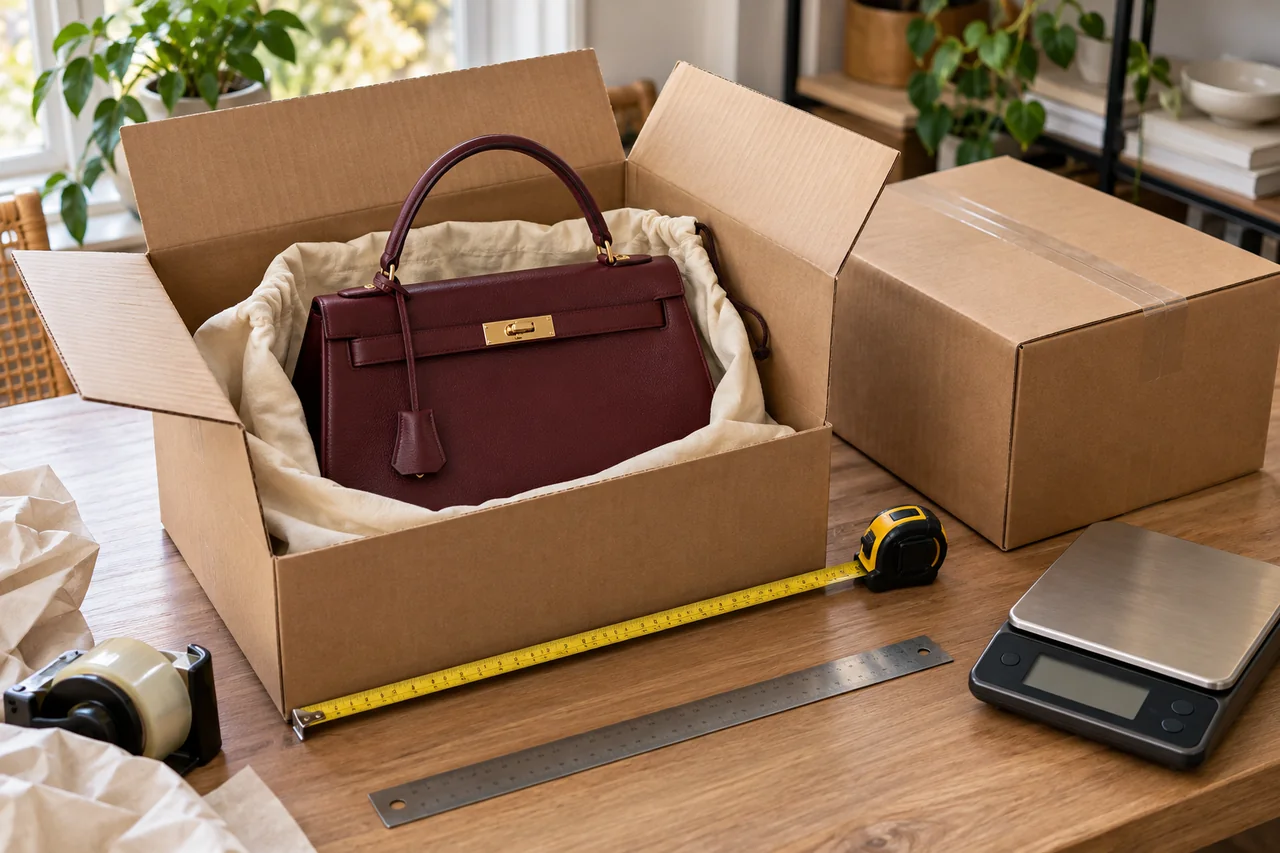
An individual bag’s listing dimensions are not its shipping dimensions. Stuffing, handles, protective sleeves, retail boxes, separators and the outer carton can all change the final package. Obtain a measurement after the agreed packing is complete and the carton is sealed.
Record the largest external length, width and height, including bulges where the carrier’s measurement method requires them. Weigh the complete package, including carton and packing materials. Save the carton ID, units inside, photo of the measurement and scale reading.
Keep units visible. Centimeters, inches, kilograms and pounds cannot be mixed in the same formula without conversion. A divisor is meaningful only with its associated measurement and weight units.
Separate physical volume from dimensional weight
For a rectangular carton measured in centimeters:
Carton volume in cubic meters = length × width × height ÷ 1,000,000.
For a service using a centimeter-based dimensional divisor:
Dimensional weight in kilograms = length × width × height ÷ the applicable divisor.
These formulas produce different quantities. Cubic meters describe space; dimensional kilograms are a billing convention.
Swipe the table horizontally to see all columns.
| Field | Example input | What it means |
|---|---|---|
| External dimensions | 50 × 40 × 30 cm | Hypothetical sealed-carton measurements |
| Physical volume | 0.060 m³ | 60,000 cm³ divided by 1,000,000 |
| Actual gross weight | 8 kg | Hypothetical scale reading |
| Illustrative divisor | 5,000 cm³/kg | Use only if the selected service confirms it |
| Dimensional result | 12 kg | 60,000 divided by 5,000 |
| Comparison basis | 12 kg before further rules | Higher than the example actual weight |
All dimensions and weights in this table are invented for arithmetic instruction. No shipping price is implied.
What official carrier examples show
DHL’s Singapore educational guide describes a typical DHL Express calculation using centimeters and a divisor of 5,000. It also explains comparing volumetric and actual weight. This supports the example method, not the assumption that every available route uses the same divisor. DHL volumetric-weight guide
FedEx’s Australia FAQ gives a centimeter-based divisor of 5,000 and instructs readers to round dimensions upward to the next centimeter. It also distinguishes inch-based calculations producing kilograms from those producing pounds. FedEx Australia dimensional-weight FAQ
Read the page relevant to the actual service and confirm its current commercial terms. Do not copy a rounding rule from one regional example into an unrelated freight quotation. Carrier remeasurement, minimum charges, weight increments or other applicable rules can change the final billed amount.
Compare packing changes without sacrificing the bag
Suppose the hypothetical 50 × 40 × 30 cm carton can safely become 50 × 40 × 25 cm after an approved packing change. Volume falls from 0.060 to 0.050 m³. At the illustrative divisor of 5,000, dimensional weight falls from 12 to 10 kg. If gross weight remains below both values, the dimensional comparison improves, but the actual money saved still depends on the tariff and other charges.
Before approving that change, identify what is removed or compressed. A structured bag may need support to preserve shape. Hardware may need separation to avoid rubbing. Removing a presentation box may affect your intended retail offering.
Ask for a revised packing photo, measurements and gross weight.
Keep a separate record for every carton
For a multi-carton shipment, list each carton’s dimensions and weight. Ask whether the service calculates dimensional and chargeable weight per package or at shipment level, and how rounding is applied. Adding raw volume first can produce a different result from rounding each package separately.
Use this quotation request template:
“Destination and postcode; service or route proposed; carton IDs; units per carton; external dimensions and units; gross weight and units; divisor; measurement and weight rounding; package versus shipment calculation; included charges; exclusions; quote validity; remeasurement process.”
The 1688 Bags sourcing page asks for quantity, destination and budget as part of quote review. Provide final packing data when available and label early measurements as estimates.
Sources and next step
Sources checked 2026-10-16: the linked DHL Singapore and FedEx Australia official guidance, plus the 1688 Bags sourcing page. Worked examples are hypothetical and exclude pricing.
Send your packing requirements for review. Include whether folding, removal of retail packaging or changes to shape support are permitted.
Recalculate with your own inputs
The example is prefilled in cm and kg. Replace the divisor with the quoted service rule; values stay in this page.
Carrier dimension/weight rounding and additional charges are not calculated. This is a weight basis, not a freight quote.
Request a carton-by-carton freight basis
Edit this local table, then copy it into your sourcing request. Entries are not saved or sent automatically.
Example / reference — edit the fields below
C01 / 60×40×35 cm / 12 kg / divisor 5000 →16.8 kg before rounding
Sources and calculation method
Research reference date: . This is a source-reference date, not a publication date or a hands-on test.
Method: the editorial comparisons use the cited specifications; worked calculations state their assumed inputs. Product-page descriptions do not establish physical fit, material performance or stock.
Questions before purchase
Is 5,000 always the correct divisor?
No. It appears in the cited carrier examples, but the applicable service and agreement control your shipment. Confirm the divisor and units in writing.
Can I estimate shipping from the bag’s listed dimensions?
Only as an early assumption. Use sealed-carton external measurements and complete package weight for a meaningful final review.
Does lower dimensional weight guarantee a lower invoice?
No. Actual weight, billing increments, minimums and applicable surcharges can affect the result. Request a revised total quotation rather than treating dimensional kilograms as a price.